
The amateur tech landscape is still stuck in the “linear prompt” phase—typing a single command into a chatbot web interface, waiting for a localized text block, manually fixing it, and repeating the process over and over. It is a slow, ceiling-limited workflow that turns the human into the manual engine of the system.
The elite tier of tech architects and digital asset builders are moving elsewhere. They are building Agentic AI Loops: autonomous, multi-agent frameworks that ingest a high-level operational goal once, then recursively execute, monitor, audit, and adapt their own execution lines until the job is completed flawlessly.
By moving away from cloud-heavy SaaS dependencies and designing local, closed-loop automation, solo creators and lean startups are slashing software overhead by up to 80% while scaling output by a factor of ten.
The 2026 Quick Summary: If you want to stop paying for expensive single-feature middleware subscriptions and immediately orchestrate automated, multi-channel email marketing and content funnels on a permanent freemium infrastructure, Systeme.io provides the best unified visual framework to deploy loops instantly. If you are scaling custom local script environments using autonomous models like Claude Code, tools like Mira allow you to turn raw developer code into modular, reusable system skills.
The 5 Pillars of a High-Conversion AI Loop
To move out of the manual chat box and into autonomous production, your automated content or data loops require five distinct software architectural layers:
- The Automation Heartbeat: The scheduling layer or cron trigger that executes the task automatically on a strict time pattern, requiring zero human clicks to launch.
- The Skill Directory: Saved, immutable operational instructions and strict boundary rules that the AI reads on every pass, eliminating text prompt degradation.
- The Worker and Verifier Split: Separating the agent doing the work from a stricter, more precise monitoring model that acts as a quality gatekeeper. An AI writing agent should never grade its own homework.
- The Environment Connector: The API endpoints that allow the system to physically act inside your software apps (e.g., publishing a post or sending an invoice), rather than just suggesting a fix.
- The Stop Condition: The hard programmatic boundary line that cuts off the loop once success is achieved or a maximum try limit is reached, protecting your API bills from runaway token loops.
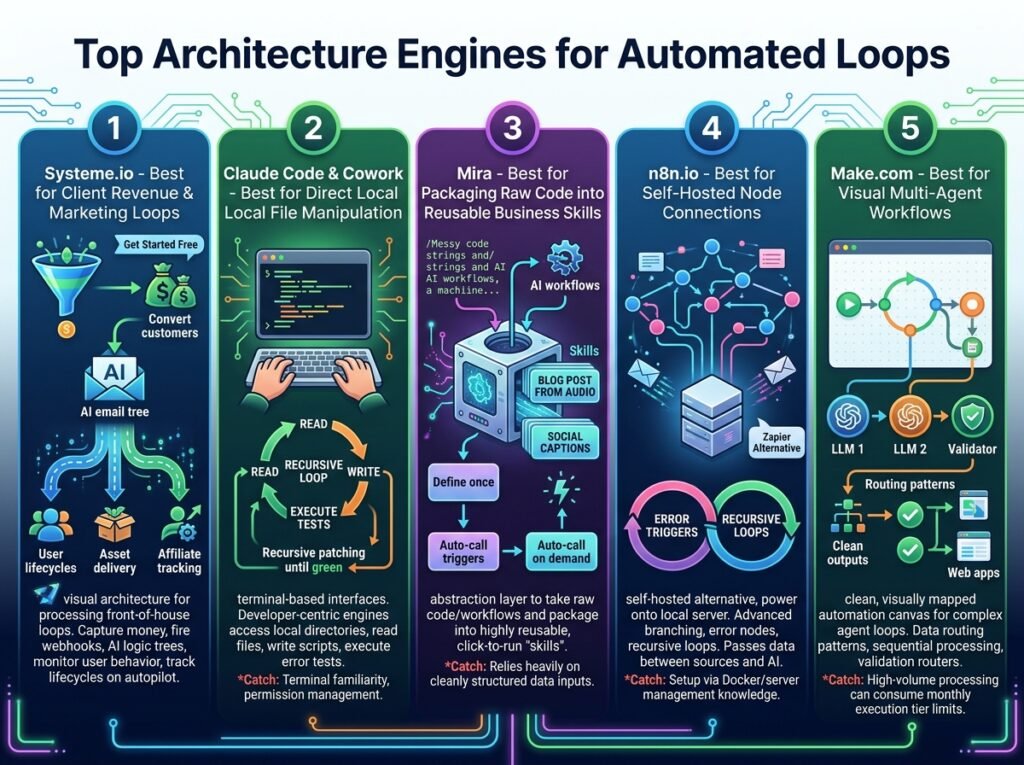
Top Architecture Engines for Automated Loops
1. Systeme.io – Best for Client Revenue & Marketing Loops
While engineering standalone terminal scripts is great for backend developers, businesses require frontend customer loops to capture money. Systeme.io functions as a robust visual architecture engine for processing front-of-house loops.
- The Revenue Loop: You can design a loop where incoming web traffic automatically fires a web webhook, triggering an AI email logic tree that monitors user behavior, delivers specific target assets, dynamically updates your affiliate data tracking table, and tracks user lifecycles on absolute autopilot.
- Get Started Free: Build your front-end revenue loop with Systeme.io for free here.
2. Claude Code & Cowork – Best for Direct Local File Manipulation
Anthropic’s terminal-based interfaces have completely shifted advanced developers away from basic browser windows.
- The Execution Loop: By running tools locally on your system, these developer-centric engines can directly access local directories, read code files, write scripts, execute error tests, and recursively patch bugs on loops until the build returns green.
- The Catch: It requires basic terminal familiarity and careful management of local system permissions.
3. Mira – Best for Packaging Raw Code into Reusable Business Skills
Mira acts as a critical abstraction layer that allows you to take raw code strings or intricate AI workflows and package them into highly reusable, click-to-run “skills”.
- The Execution Loop: Instead of typing out 500-word prompts daily, you define a skill once (e.g., “Ingest raw audio note, convert to SEO blog post, and draft 3 multi-platform social captions”). The automation framework calls the skill on demand via simple triggers.
- The Catch: It relies heavily on cleanly structured data inputs to maintain output consistency.
4. n8n.io – Best for Self-Hosted Node Connections
If you are tired of soaring monthly automation bills from cloud platforms like Zapier, n8n is the ultimate self-hosted alternative that puts the power of complex logic branches straight onto your local server.
- The Execution Loop: Featuring advanced branching logic, error-trigger nodes, and recursive loops, n8n handles deep multi-app connections. It passes data payloads back and forth between your data sources and AI models seamlessly.
- The Catch: Setting it up locally or via a private virtual server requires basic knowledge of Docker or server management hosting.
5. Make.com – Best for Visual Multi-Agent Workflows
For non-developers who want a clean, visually mapped automation canvas to control complex agent loops without looking at raw code files, Make remains a market giant.
- The Execution Loop: It excels at building clear routing patterns where data strings can be broken down, processed through various specialized AI models sequentially, checked through validation routers, and sent cleanly to your web apps.
- The Catch: High-volume operational data processing loops can quickly consume your monthly execution tier limits if your data parameters aren’t optimized.
The Wolf Blueprint: How to Deploy and Profit
To break away from the crowd and maximize your operational return, build systematically:
- To anchor your marketing, capture traffic, run automated email follow-up funnels, and monetize your global audience on a free permanent ecosystem, deploy on Systeme.io.
- To completely bypass cloud software inflation, use n8n or Claude Code setups to process your data locally, keeping your operational costs locked to absolute zero.